


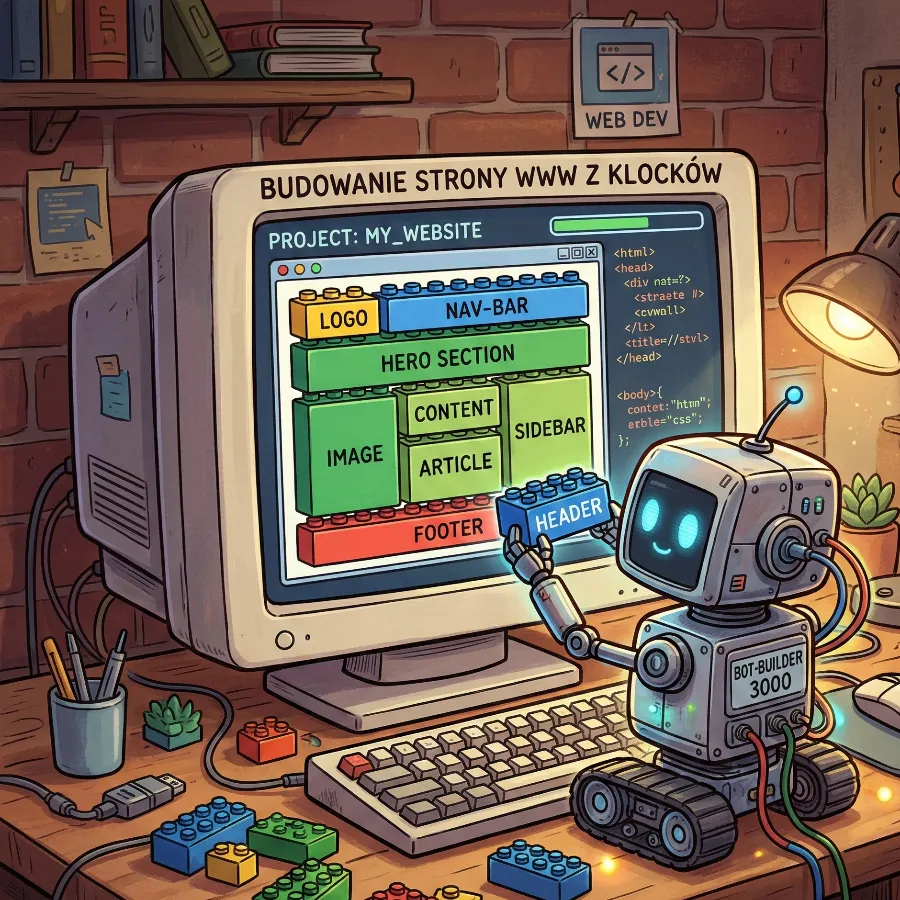

The world of web development abhors a vacuum, and the pace of innovation seems to accelerate with each passing year. Just when we thought modern page builders had reached their peak in usability and flexibility, Builderius AI enters the stage. The integration of this powerful tool with the advanced language model from Anthropic is not just another market curiosity or a fleeting trend. It is a robust, innovative solution that has the potential to completely redefine how we design, optimise, and develop sites based on the most popular CMS in the world on a daily basis.
In this article, we will take a closer look at how this solution works in practice, why the chosen artificial intelligence model makes such a massive difference, and what technological challenges—especially concerning Linux server administration, Nginx configuration, and control panels like ISPConfig—are presented by modern, automated building WordPress websites.
From Simple Editors to Builderius AI – A Brief Evolution
To fully grasp the significance of the novelty that is Builderius AI, it is worth looking at the evolution of site-building tools. Initially, the WordPress ecosystem relied on simple text editors and cumbersome shortcodes. Then came the era of visual “Drag & Drop” editors, which democratised web design, allowing individuals without deep programming knowledge to create aesthetically pleasing sites.
However, traditional page builders, despite their advantages, often generated excessive, “heavy” code (the so-called div soup), which negatively impacted performance and Core Web Vitals scores. Builderius has always positioned itself as a tool for professionals—developers who want full control over HTML, CSS, and structure, but within a convenient graphical interface. Introducing machine support into this ecosystem is a natural step forward. Instead of manually writing complex queries or CSS Grid structures, a developer can now delegate this task to an assistant.
What Exactly is the Experimental Builderius AI Integration?
The creators of the popular builder recently announced the introduction of a fully experimental, yet incredibly promising feature. It allows for advanced structural, logical, and visual changes to be made directly from within the editor, using natural language.
By harnessing the potential offered by Claude artificial intelligence, developers can now automate routine tasks much faster. Unlike simple AI assistants available in SEO plugins (which merely generate blocks of text or meta tags), Builderius AI can analyse and modify the architecture of the page itself.
Imagine a situation where you need to create a custom WooCommerce product grid with specific filters and hover animations. Instead of writing dozens of lines of CSS code and PHP queries, you can instruct Builderius AI to prepare the appropriate DOM structure and generate optimal classes. The assistant can create dynamic components, modify existing modules, and adapt them to responsive web design (RWD) requirements in a fraction of the time it would take a human.
Why Claude Artificial Intelligence from Anthropic?
The choice of the engine driving this type of integration is not without significance. The creators of Builderius opted for solutions from Anthropic. Why specifically Claude artificial intelligence, and not the popular GPT family models from OpenAI?
The answer lies in the architecture and specifics of these models. Claude is renowned for its massive context window and extraordinary precision in tasks related to programming and analysing structured data (such as HTML, JSON, or WordPress database structures). Claude artificial intelligence can “hold in memory” a very broad context of the entire page view, which minimises the risk of hallucinations—a situation where the AI generates code that is syntactically correct but completely out of place with the rest of our website.
For professionals, this means that the generated code is cleaner, more optimised, and compliant with modern web standards, perfectly aligning with the philosophy of the Builderius builder itself, which prioritises performance.
Modern Building WordPress Websites Requires Robust Infrastructure
As specialists, server administrators, and technology enthusiasts gathered around the CreativeArt blog, we always pay close attention to what happens under the bonnet. Even the most optimised and innovative building WordPress websites with the help of AI requires an absolutely uncompromising infrastructural foundation.
The combination of lightning-fast hosting described on a high-performance Nginx web server, coupled with the flexible ISPConfig management panel, constitutes an ideal environment for working with such advanced solutions. When we use Builderius AI, our WordPress instance must communicate in real-time with Anthropic’s external API, transmit enormous data packets (page context), receive the response, and then process and render it on the PHP server side.
Nginx and PHP-FPM: Configuration for AI
Why is the server environment so critical here? Primarily due to script execution time limits. Communication with the artificial intelligence API can take anywhere from a few to over a dozen seconds. In standard, shared hosting environments based on old Apache configurations, this often results in a 504 Gateway Timeout error.
Professional building WordPress websites using AI assistants requires the administrator to appropriately fine-tune Nginx and PHP-FPM parameters. In the ISPConfig panel, for a domain utilising Builderius AI, we recommend implementing the following directives in the Custom Nginx Directives section:
- Increasing
fastcgi_read_timeoutto a minimum of 120 seconds (or more, depending on the complexity of the AI queries). - Appropriately tuning
max_execution_timein the PHP settings. - Increasing
memory_limit(compiling large structures generated by AI on the fly can be resource-intensive).
Only a properly configured Nginx server is capable of handling such asynchronous, demanding processes without dropping connections to the browser of the user working in the editor.
Security and Control in the Era of Code Generators
Every experienced Linux systems administrator and network security enthusiast will ask a crucial question at this point: is allowing artificial intelligence to directly make changes to the site structure secure?
Builderius AI operates in a sandboxed environment and is subject to the permissions of the user logged into the WordPress panel. Nevertheless, generating code on demand always carries the risk of injecting an unwanted script (e.g., in the case of prompt injection). This is exactly why using panels like ISPConfig gives us an advantage. We can run development sites in strictly isolated chroot environments, utilise ModSecurity rules (WAF – Web Application Firewall), and precisely manage system user permissions.
It is worth remembering that although Claude artificial intelligence writes high-level code, the final verification and approval (code review) always rests with a human. Modern development environments (staging) are practically mandatory before modules generated by AI reach the production environment (live).
Will Builderius AI Replace Developers and Administrators?
This question arises with every new technological revolution. The answer is: no, but it will drastically change the way they work.
Tools like Builderius AI do not eliminate the need for technical knowledge. On the contrary—to write an effective prompt for the AI, you need to thoroughly understand how CSS Flexbox, Grid, the logic of WordPress database queries, or DOM structures work. Only the role of the developer changes—from a “code writer” to a systems architect and “prompt engineer”.
Companies and agencies implementing automated building WordPress websites will be able to deliver advanced projects much faster. However, without solid knowledge of Linux server configuration, Nginx optimisation, or network management, no advanced builder will run stably.
The Future or a Passing Trend? Summary
Although the discussed integration is largely an experimental feature at the moment, it incredibly clearly indicates the direction in which the entire web industry and the CMS market are heading. Builderius AI forcefully proves that advanced machine models are no longer just SEO plugins suggesting keywords for articles or image generators for blog posts. They are becoming fully-fledged, capable programming assistants operating directly within our workspace.
For every modern administrator, advanced developer, and enthusiast of modern technologies centred around the CreativeArt community, this is a very clear signal. We should not ignore this revolution. It is worth testing the latest technological innovations, experimenting with integrations, and pushing their boundaries. Provided, of course, that our server backend, knowledge of Linux systems, and network security policies are fully prepared for it.
It is time to start treating AI not as a novelty, but as an integral tool in our development and server arsenal.
Leave a Reply